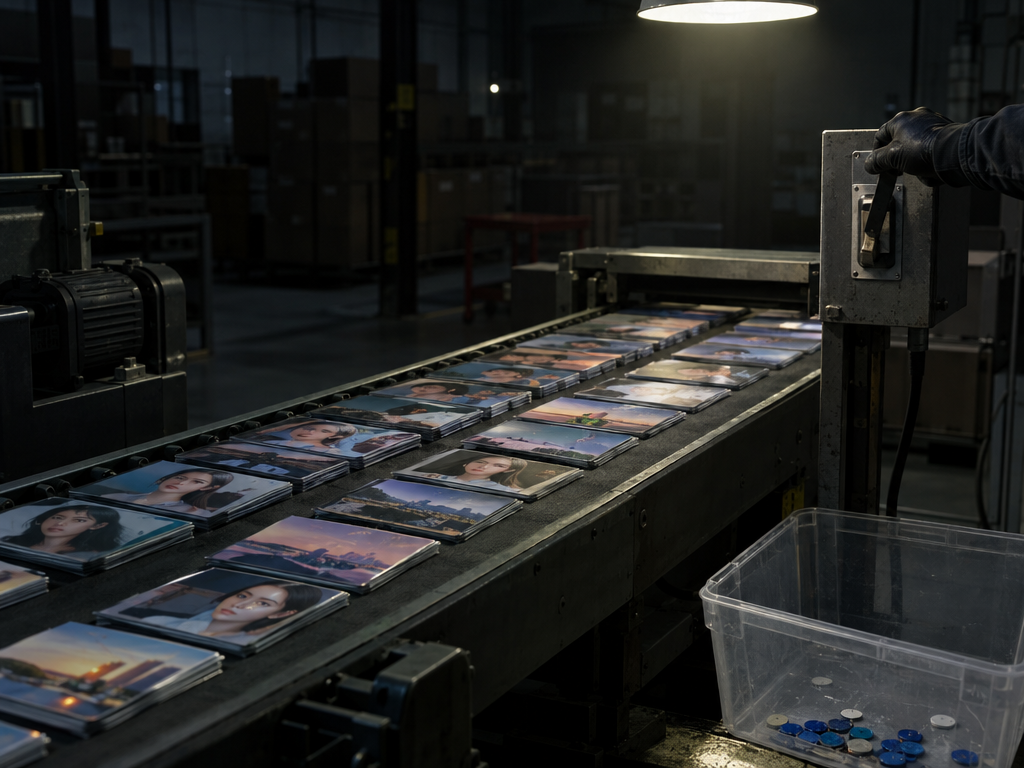
YouTube just cut off the AI slop money machine
YouTube spent this week drawing a line most of us have wanted drawn for a while. It spelled out, in plain language, which videos will no longer earn a cent: the mass-produced template channels, the fake-expert AI "doctors" and "lawyers," and the emotionally manipulative slop built to farm clicks and nothing else. If your video has a human point of view, you are fine. If it is a factory wearing a face, the money stops.
We also dug into one indie game that has quietly taken over long-form YouTube this summer. A body-paint hide-and-seek game called Meccha Chameleon has swept thousands of channels since June, and the data shows it holding on far longer than these trends usually do. And in Creator on the Rise, we meet a filmmaker who shot a movie for eight hundred dollars, put it on YouTube for free, and turned it into a nine-figure Hollywood career.
It is also one of the busiest release weeks of the summer, with Comic-Con, Streamer University and a new Battlefield season all landing at once. Let's get into it.
Brand new from ThoughtLeaders
Our Chrome Extension Is Here
Our brand new Chrome extension drops ThoughtLeaders data and insights right onto YouTube as you watch, so the moment a creator catches your eye you can tell whether they are worth working with, without ever leaving the page. It is free, live in the Chrome Web Store, and two clicks to add.
This week's deep dive
YouTube Draws Its Line Against AI Slop
On July 13, YouTube published a rewrite of its inauthentic content monetization rules. Officially it is a clarification rather than a new policy, but the plain-language version lands like a statement of intent. Three kinds of content are now clearly ineligible to earn ad revenue: generic or repetitive videos built from templates or churned out at scale, "unsatisfying or off-putting" content such as fake celebrity-death thumbnails and emotionally manipulative formulas, and AI-generated "experts" holding forth on health, legal, financial or political topics.
The phrase doing the heavy lifting is content produced through "mass production without adding the creator's original, authentic insights or perspective." That is YouTube naming the AI-slop economy out loud. Over the past two years, whole networks of channels have learned to spin up dozens of near-identical faceless videos a day, stitched together from stock footage, synthetic voiceover and recycled scripts, all aimed at gaming the recommendation engine rather than earning an audience. YouTube is not deleting these videos. It is doing something more surgical, leaving them up and switching off the money.
The timing is not an accident. YouTube spent the last year loosening rules that irritated real creators, from allowing profanity early in a video to expanding fan funding and native shopping. This is the other side of that trade. If you are going to make it easier for authentic creators to earn, you also have to make it harder for the slop farms to free-ride on the same ad pool. The company says the rewrite gives its reviewers "clearer, more actionable language so creators know why a channel gets flagged," which in practice also means faster and more defensible demonetization at scale.
For brands, this is quietly good news. The single biggest anxiety in creator advertising is landing next to garbage, and the fastest-growing category of garbage is exactly the automated, low-effort content YouTube just de-funded. Every dollar pulled out of the slop economy pushes ad inventory back toward the creators who genuinely hold attention. It also sharpens a question every marketer should already be asking: is the "creator" you are paying a person with a real point of view, or a content factory wearing a face.
Zooming Out
For a decade the working definition of a good YouTube video was simple: one that performed. The view count was the whole scoreboard. What YouTube signaled this week is that performance alone is no longer enough to get paid. The platform is now willing to separate content that merely accumulates views from content that carries a genuine human perspective.
The story behind the numbers
From Our Data
One Game, 1,626 Channels, 459 Million Views
One indie game has quietly taken over long-form YouTube this summer, and it is not a Fortnite or a Roblox. It is Meccha Chameleon, a body-paint hide-and-seek game where you camouflage yourself and hide in plain sight. Since June it has appeared in the title of 3,810 long-form videos from 1,626 different channels, pulling 459.2 million views. That is a staggering footprint for a single game, and it has held on far longer than these format waves usually do. Most game trends burn through creators in two to three weeks. This one has been running strong for well over a month.
It is finally cooling, though. Weekly uploads peaked at 1,031 in the week of June 22, held near that at 1,007 the following week, then eased to 756 in the first week of July and have kept sliding since. The wave has crested. What is striking is that the biggest hits are still landing this late: several of the standout videos below were posted in July, well after the moment most trends would have burned out.
Meccha Chameleon standout vs the channel's normal video (90-day median)
SQUEEZIE GAMING · 2.47M vs 592K normal (Jun 23)
4.2x
VanossGaming · 2.96M vs 747K normal (Jun 19)
4.0x
Disguised Toast · 1.99M vs 620K normal (Jul 5)
3.2x
MoreSidemen · 4.06M vs 1.82M normal (Jul 4)
2.2x
SMii7Yplus · 3.59M vs 1.64M normal (Jul 10)
2.2x
Each bar measures a creator's biggest Meccha Chameleon upload against the median views of their own long-form videos in the 90 days before the game existed for them. France's SQUEEZIE ran 4.2 times his normal numbers, and VanossGaming nearly matched him at 4.0. Note the dates: the Sidemen posted their standout on July 4, Disguised Toast on July 5, and SMii7Y's second channel landed a 3.59 million-view hit on July 10. More than a month in, established creators are still beating their own ceilings with this one game, and the wave stayed genuinely global, with breakout entries from France, Spain, Brazil and Turkey.
Why it matters
This is format virality, powered by the game rather than the channel, which is why mid-pack creators keep beating their own numbers. The surprise is the tail. A format this sticky can run for more than a month, and the overperformance does not vanish the moment upload volume dips. For brands the timing lesson is sharp, ride a format like this fast before the inventory reprices against the new numbers, but there is a second lesson in the tail: even now, with weekly uploads falling, a well-placed video can still clear multiples of a creator's normal reach. The wave is receding, not gone.
Links Roundup
Quick hits from across the web
→ A new study found YouTube still surfaces eating-disorder videos in its recommendations months after it promised to restrict them, a reminder that platform-level brand safety is never quite finished.
→ Spotify turned its once-a-year Wrapped into a year-round AI chatbot for premium users, betting that fan data is worth far more as an always-on conversation than a single December stunt.
→ TikTok pushed its AI-transparency tools past the simple "AI-generated" label, adding features meant to help viewers actually understand when what they are watching is synthetic.
→ Nathan Barry's creator platform Kit now serves 550,000 creators and is leaning hard into offline events, a sign that email lists and real-world community are becoming the creator economy's most durable assets.
→ Fresh research on creator-driven sales put hard numbers on something brands already sensed: creator recommendations move product, and the lift is large enough to reset what a sponsorship is worth.
Add to your watch list
Creator on the Rise
Curry Barker
Horror short films & comedy • ~1.5M subscribers • US
If our deep dive is about what happens when YouTube stops rewarding content with no human behind it, Curry Barker is the other end of that story. The 26-year-old from Mobile, Alabama built a following on the sketch channel "that's a bad idea" (about 1.5 million subscribers with his collaborator Cooper Tomlinson) and a run of homemade horror shorts, one of which, "The Chair," was watched more than 10 million times. In 2024 he released a found-footage feature called Milk & Serial, made for a reported eight hundred dollars, for free on YouTube. Then his 2025 film Obsession, shot for around $750,000, grossed over $403 million worldwide. Hollywood noticed. This spring he signed on to direct A24's revival of the dormant Texas Chainsaw Massacre franchise, and in June he closed an eight-figure deal with Universal and Blumhouse for an original horror film. The IP angle is worth sitting with: a filmmaker who learned his craft posting free shorts is now being handed a decades-old studio franchise to reawaken. For brands, Barker is a preview of where premium narrative talent is coming from. The next generation of directors with real, portable audiences is being incubated on YouTube, on tiny budgets, in exactly the authentic, human register the platform just moved to protect.
Advertiser Spotlight
Brand Strategies Worth Stealing
Lowe's Turned Its Creators Into a Product Lab
Lowe's just did something most brands still would not dream of. With a program it calls Creator: Into the Blue, the home-improvement giant opened its 28,000-person first-party creator network, the first of its kind in the category, to actual product development. Creators can now pitch product ideas across Lowe's categories and, if selected, work with the company's design, sourcing and merchandising teams toward real retail distribution. Applications are open through September 1. It builds on an earlier MrBeast collaboration that put exclusive Lab Swarms toys on shelves and on Lowes.com.
The move worth stealing is treating creators as product partners, not just a media channel. Most brands still see a creator relationship as a place to buy attention: run the integration, count the views, move on. Lowe's is betting that the same creators who understand an audience also understand what that audience wants to buy, and it is giving them a path from idea to store shelf. CMO Jen Wilson framed it as the natural next step now that "creators are evolving their ideas and audiences into businesses, brands, and products." For any brand with a creator roster, the question is no longer only what your creators can help you sell. It is what they could help you build.
Trending on YouTube
What's going viral right now
San Diego Comic-Con Takes Over the Feed July 23-26
Comic-Con returns with a Preview Night on July 22, and this year Marvel is back in Hall H ahead of "Avengers: Doomsday," with Prime Video showing "The Rings of Power" season 3 and "Blade Runner 2099." Expect a flood of trailer drops, first reactions and panel clips across the platform. See the schedule.
Battlefield 6 Sails Into Naval Warfare July 21
Season 4 brings naval combat to Battlefield 6 for the first time, with a huge new map called Tsuru Reef built around boats, jets and dynamic waves. Gaming YouTube is already deep in the gameplay trailer, and the launch should fill feeds with first-impressions and highlight reels. Watch the gameplay.
Kai Cenat's Streamer University Is in Session
Running July 15 to 20, the second year of Kai Cenat's creator bootcamp packs roughly 120 students onto one campus, with professors from Ludwig to Pokimane to T-Pain. It is a week of nonstop collabs and livestreams engineered to spin off viral clips by the hundred. Watch it unfold.
Open Sauce Gathers the Maker Creators July 17-19
William Osman's science-and-engineering festival returns to San Mateo this weekend with a lineup that reads like a STEM-YouTube dream team: Mark Rober, Vsauce, Hank Green, Michael Reeves and JerryRigEverything among them. Three days of homemade robots and backyard experiments, most of which become videos. See the lineup.
"Crystal Lake" Drops Its First Teaser
Peacock's "Friday the 13th" prequel series released its first footage this week, with Linda Cardellini as a young Pamela Voorhees, and horror YouTube is already deep in frame-by-frame breakdowns. The eight-episode series itself does not premiere until October 15, so the reactions will run for a while. Watch the teaser.


