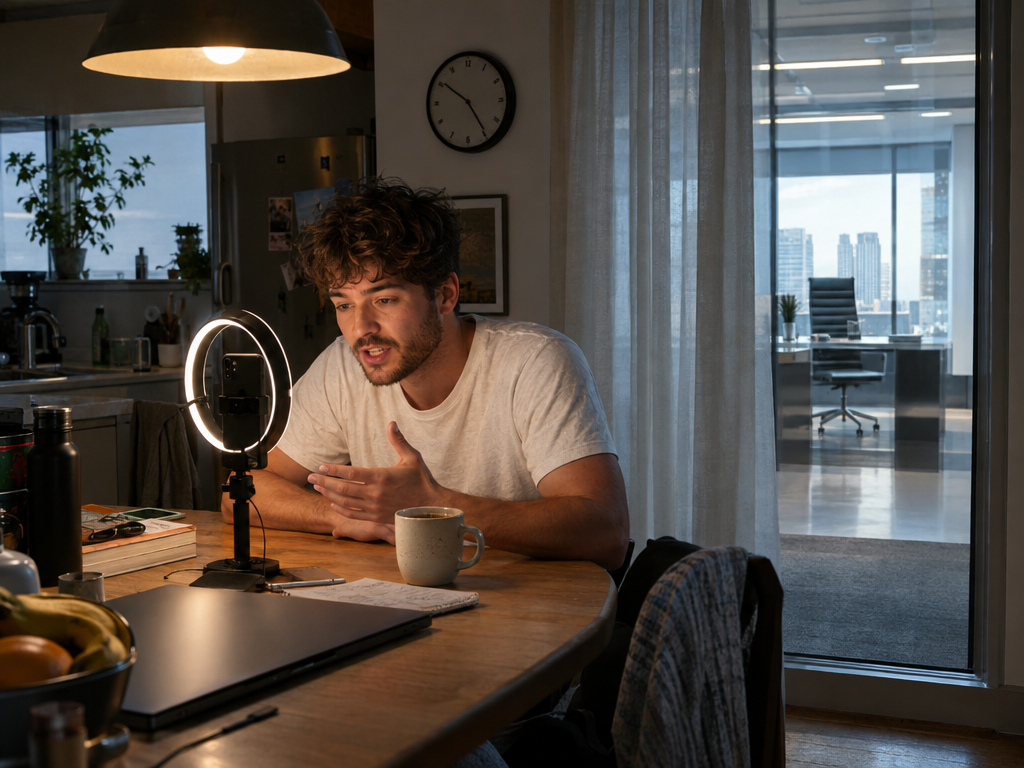
Colbert just skipped the network. Here's the play.
Stephen Colbert hosted his last Late Show on May 21. By Saturday morning, he had a personal YouTube channel up under the handle @colbert, no network in sight, and was already most of the way to 200,000 subscribers on a single upload, an hour-long visit to a public-access station in Monroe, Michigan. The 33-year Late Show franchise ended on Thursday and the post-network version of Stephen Colbert started on Saturday. That gap is the whole story of where late night is going.
Also in this week's issue: an F1 race weekend that produces more views than most channels see in a year, an Indianapolis 500 that came down to two hundredths of a second, and a Sidemen vs France charity match at Parc des Princes that proved creator soccer now travels with a passport. Let's get into it.
This week's deep dive
Colbert Did Not Retire. He Switched Platforms.
The Late Show with Stephen Colbert ended on Thursday, May 21, with a 90-minute extended final episode and a long curtain call. CBS announced the cancellation in July 2025 and retired the entire Late Show franchise after 33 years, 22 of them under David Letterman and 11 under Colbert. The official Late Show YouTube channel, which still has 10.8 million subscribers and pulled 5.5 million views on a single finale-week monologue clip, went dark for new uploads the same night.
Then on Friday, hours before the finale aired, Colbert quietly registered the TikTok handle @colbert. By Saturday morning a matching YouTube channel was live. The first upload was titled "Only In Monroe, May 22, 2026," a one-hour appearance on a public-access station in Monroe, Michigan, that any Late Show writer would tell you reads as a direct sequel to Colbert's old "Better Know A District" bit. The channel passed 120,000 subscribers within 48 hours of the upload and is sitting close to 200,000 as I write this. The TikTok side has cleared 140,000 followers on zero content. The brand recognition is doing all the work.
The reason to pay attention is not that one famous person started a YouTube channel. The reason to pay attention is the speed and the format. CBS spent 11 years building a late-night Colbert brand worth somewhere north of $50 million a year in ad revenue. The decision to retire that franchise was a network decision, and the host had no say in it. The decision to skip the next-network search and go directly to YouTube and TikTok, with no production company involved, no holding deal, and no network exclusivity clause, was made in roughly the time it took to register two URLs. The infrastructure to do this did not exist three years ago. It barely existed 18 months ago. By the time the next late-night host gets cancelled, it will be the default move.
The interesting question is the format. Colbert's first upload is an hour long. That works for legacy fans who came over from CBS, but YouTube Shorts is where comedy actually compounds for personality-led creators in 2026. Tubefilter's analysis flagged the same point: his old "The Word" segments from the Colbert Report era are basically modern Shorts already, just trimmed. If he ports the "Better Know" and "The Word" muscle memory into 60 to 90 second vertical clips, the algorithmic ceiling here is a different category. If he sticks with long-form public-access throwbacks, the audience will be loyal but capped. The first 90 days will tell us which way it goes.
Zooming Out
The Late Show is the third major late-night franchise to end or downsize in 18 months. The pattern is now clear enough to plan against. Network late-night was a sponsorship category worth roughly $400 million a year at its 2018 peak, with brand integrations baked into the monologue and the desk segments. That money does not disappear. It rotates. Some of it goes to YouTube creator shows that look like late-night without the network overhead (Kareem Rahma's "Keep the Meter Running," which we cover further down, is exactly this). Some of it goes to host-read podcast inventory. The takeaway for any brand currently running pre-roll against late-night clips on YouTube: the talent is still on YouTube. The structure around the talent has just shed two layers of middlemen. The integration price for the same audience is about to drop, and so is the timeline to get a deal live.
The story behind the numbers
From Our Data
One F1 Race Weekend Equals a Year of Highlights
Formula 1's official YouTube channel has 14.7 million subscribers and a typical projected view count of about 530,000 per upload. That projection holds on a normal week. Then a race weekend lands. The 2026 Canadian Grand Prix ran May 22 to May 24 in Montreal, and the four core race-weekend highlight uploads pulled 17.9 million combined views in five days, against a baseline that says any one of them should have done around half a million.
Canadian GP highlight uploads vs. typical F1 video
May 24 · Race Highlights
6.78M · 13x
May 23 · Sprint Highlights
4.52M · 8.5x
May 22 · Sprint Qualifying Highlights
3.60M · 6.8x
May 23 · Qualifying Highlights
2.97M · 5.6x
May 22 · FP1 Highlights
1.12M · 2.1x
Top 4 race-weekend highlights combined: 17.86M views in five days. Add FP1, post-race shows, F2 races, Shorts, and onboard clips and the channel pushed roughly 30 unique uploads from May 21 to May 27 alone. Channel-wide weekly view total: north of 35M, against a typical week closer to 5M.
Why it matters
F1 is not a YouTube channel that happens to cover a sport. It is a content factory that turns one weekend of physical-world events into 30+ uploads, each with its own watch-time profile, sponsorship slot, and audience overlap. The race highlight gets the casual fans. The qualifying highlight gets the strategists. The 10-second meme Shorts get the algorithm. The post-race show gets the lifers. A brand that bought a single weekend integration on the FORMULA 1 channel is, in practice, buying inventory across five distinct programming verticals at once. There are 24 races on the 2026 calendar. Multiply this content stack across all of them and you understand why F1's media valuation has tripled in five years. It is not the racing. It is the publishing cadence.
Links Roundup
Quick hits from across the web
→ YouTube Creator Partnerships went live this week as the official replacement for BrandConnect, with Gemini doing the brand-to-creator matching across a pool of 3 million eligible channels and the workflow now built directly into both YouTube Studio and Google Ads. It rolled out in 7 markets first. Worth tracking for what it does to the discovery layer of the sponsorship funnel.
→ TikTok named its 2026 FIFA World Cup Creator Correspondents this week, a global roster of creators credentialed to cover matches, training sessions, and host-city programming as official talent. This is the first World Cup with a creator credentialing tier that sits alongside traditional broadcast press, and the rollout is being run jointly with FIFA's commercial team.
→ YouTube's AI content-labelling system got a meaningful overhaul on Wednesday. Labels are now applied automatically to videos detected as AI-generated rather than relying on creator self-disclosure, with clearer placement on the video player and a re-worded "Altered or synthetic content" tag. Brand-safety teams should expect new flags on inventory that previously read as clean.
→ The Sports Emmys streamed live on May 26 and the News & Documentary Emmys ran May 27 and 28, both on the NATAS YouTube channel as the official ceremony broadcast. That is a 30-year-old TV awards ceremony that is now first-party on YouTube before anywhere else. Worth noting for how fast the creator-vs-TV question is being settled by the awards categories themselves.
→ Paris Hilton dropped a TikTok series tackling explicit deepfakes on Wednesday, the first episode walking through what creators and parents can do when a synthetic image lands. She is using her own platform to push a policy fight, with the second episode aimed directly at platform-level reporting tools. Expect this to be referenced in every brand-safety briefing through Cannes.
Add to your watch list
Creator on the Rise
Kareem Rahma
Comedy / Personality-Led Documentary • ~1M YouTube Subscribers • US
Kareem Rahma is the Egyptian-American comedian behind "SubwayTakes," the now-ubiquitous interview format where he holds a microphone in front of New York subway riders and asks for their hottest take. He has 1.7 million followers on TikTok, 2.7 million on Instagram, and just under 1 million YouTube subscribers. His current YouTube show "Keep the Meter Running" inverts the cab ride: he gets in, the driver picks the destination, and they go wherever it is. The reason this matters now is that the show was originally developed inside CNN, sat in a vault for seven months, and finally debuted as a YouTube web series after CNN walked away. YouTube launched it as part of the Brandcast 2026 slate this month. The IP is the same. The distribution layer is creator-owned. Brands already in: Meta, H&M, J.Crew. He sits in exactly the lane Colbert is now walking toward, except Rahma has been refining the playbook for three years.
Advertiser Spotlight
Brand Strategies Worth Stealing
Oscar Mayer (Kraft Heinz) × The Wienie 500
Two days before the actual Indianapolis 500, Oscar Mayer ran the second annual Wienie 500 on the same speedway: a six-Wienermobile race, with the fleet coached for months by real IndyCar drivers (Nolan Siegel, Stingray Robb, Scott McLaughlin), broadcast live on Fox at 2pm ET on Friday May 22 with the actual IndyCar commentary booth. Year one drew 85,000 in-person attendees and 8 million streaming views, and Oscar Mayer turned that weekend into the brand's strongest Memorial Day sales window in four years. Year two went national on Fox, added a fan-voted competitor (Corn Dog replaced Sonoran Dog), and turned the driver coaching sessions into a YouTube and TikTok content stream that has been running for months.
The lesson is the structural one. Oscar Mayer did not buy a sponsorship slot adjacent to the Indianapolis 500. They built a parody event that sits next to it and now functions as an annual brand-owned tentpole, with its own broadcast booth, its own driver coaching content, and its own fan-voting mechanic. The Wienermobile has been a Kraft Heinz asset since 1936. They reframed an existing IP as a live event property, then sold the right adjacent broadcaster on co-promoting it. Every brand that has an iconic owned asset and a quiet category moment should be asking the same question: what is the parallel event we can build that owns the cultural moment our category sits inside? The answer is rarely a sponsorship buy. It is usually a format invention.
Trending on YouTube
What's going viral right now
Mandalorian and Grogu Owns Memorial Day
Disney's Mandalorian and Grogu opened Memorial Day weekend with $100 million domestic and $163 million global, the biggest Memorial Day debut in years and the first theatrical extension of a streaming-native IP at this scale. On YouTube the trailer cycle is still climbing post-release, and the Star Wars channel pushed 12 unique companion uploads in 7 days. Watch how Disney runs the back half of the rollout. Watch the Star Wars channel.
Sidemen vs France at Parc des Princes
The "Eleven All Stars 2" charity match on May 24 put the Sidemen (Team England) against AmineMaTue's French creator roster at the actual home of Paris Saint-Germain. The Sidemen's official YouTube stream pulled 4.94 million views, AmineMaTue's Twitch broadcast peaked at 1.2 million concurrent. Creator soccer is now an export category that books national stadiums and pulls country-vs-country audiences. Watch the match.
The Indy 500 Came Down to Two Hundredths
The 110th Indianapolis 500 ran Sunday May 24 and produced the closest finish in race history. Felix Rosenqvist passed David Malukas on the final lap to win by 0.0233 seconds, after an all-time-record 70 lead changes. The IndyCar YouTube channel pushed the final-lap cut overnight and it has been ratcheting through global trending since. Watch the final lap.
Olivia Rodrigo Drops "the cure"
The music video for "the cure," lead single from Rodrigo's third album, posted May 22 and pulled 8.2 million views in six days. It is the second single from "you seem pretty sad for a girl so in love," due later this year, and she is calling it the thesis track of the record. Cat Solen and Jamie Gerin direct, and the 1950s nurse-in-her-own-hospital concept is being lifted everywhere on TikTok. Watch the video.
MrBeast Is Sprinting Toward 500M Subscribers
MrBeast posted a Short on May 22 titled "Subscribe To See 500M Play Button." It pulled 71.5 million views in six days, and he added roughly 3 million new subscribers across the week. He is on pace to be the first YouTuber to cross 500 million subs by end of June. The interesting thing is using a Short as the subscriber-acquisition machine, not a longform tentpole. Watch MrBeast.


