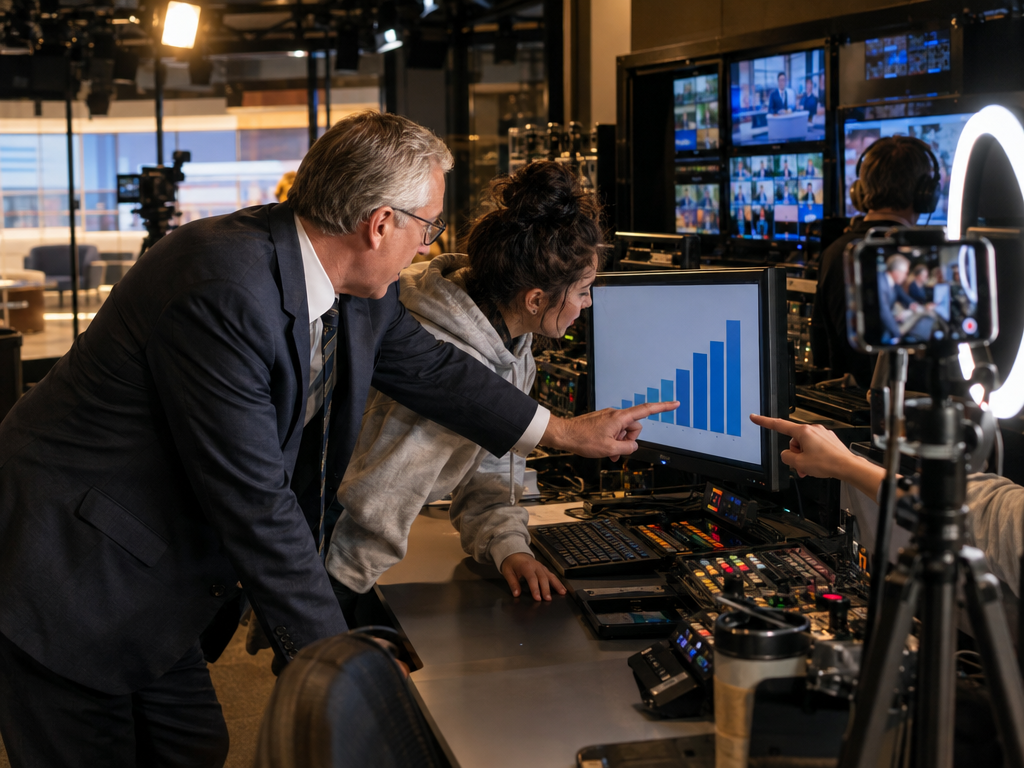
CNN just hired a YouTuber to explain the economy
This week the most establishment newsroom in America hired a new economics analyst, and she built her career on whiteboards and short skits, not a Bloomberg terminal. CNN bringing on Kyla Scanlon is a small headline with a big tell: the credibility that used to take decades to earn inside an institution can now be built in public, on YouTube, in a couple of years.
Also in this issue: the World Cup pushed a wave of creators to view counts they almost never hit, one of them to 28 times its usual numbers; Coach handed a BookTuber the keys to its Gen Z campaign; and a wildlife filmmaker most people first met on cable is quietly becoming one of YouTube's most bingeable channels. Let's get into it.
This week's deep dive
CNN Just Hired a YouTuber to Explain the Economy
On June 16, CNN named Kyla Scanlon a Contributor and Economic Analyst, attached to CNN Business. Scanlon is not a traditional economist who picked up a camera. She is a creator first. She started during the pandemic decoding markets with whiteboards and short social skits, built an audience north of a million across TikTok, Instagram, YouTube and Substack, coined the term "vibecession" that went on to shape how a whole generation talks about money, and made Barron's 100 Most Influential Women in U.S. Finance two years running. CNN says she will make multi-platform explainers on everything from tariffs to AI to the cost of college.
For most of television history, the talent pipeline ran one direction. You earned your stripes inside an institution, a newsroom, a bank, a network, and only then did you get the microphone. Scanlon ran it backwards. She built the audience and the authority out in the open, and the institution came to her. She is not a one-off, either. YouTube spent its own upfront in May programming a primetime grid around explainer-first creators like Cleo Abram and Johnny Harris, people who never worked a traditional assignment desk. The networks and the platforms are now recruiting from the same pool, and that pool is YouTube.
What CNN actually bought is trust. Scanlon's audience does not tune in because she has a title. They tune in because she explains things clearly and they believe her. That kind of earned credibility is the scarcest thing in media right now, and it does not come from a logo on a building. It gets built one video at a time, in public, in front of an audience that chooses to keep showing up.
That is the same quality that makes a creator worth a brand's money. A sponsorship works not because of reach alone, but because the audience trusts the person delivering the message. The hard part has always been telling real, durable credibility apart from a temporary spike in views, and then pricing it correctly. A newsroom hiring a creator as an analyst is just the most public version of a call brands make every week: whose word actually moves an audience, and what is that worth.
Zooming Out
For years the safe assumption was that creator credibility had a ceiling, fine for selling a protein powder, not serious enough for the evening news. CNN just removed the ceiling. When the most traditional newsroom in the country puts a YouTuber on air to explain the economy, it is telling every brand still hesitating to go bigger with creators that the credibility question has been answered. The people your audience already trusts are on YouTube. The only questions left are which ones, and whether you can tell the real signal from the noise.
The story behind the numbers
From Our Data
What a World Cup Does to a Creator's Views
The 2026 World Cup kicked off on June 11, and within days creators across YouTube were posting World Cup Shorts that blew past anything they normally do. To see how big the spike really is, we lined each one up against that same creator's usual Shorts at the exact same age. If a clip is six days old, we compare it to where that channel's previous Shorts sat six days after they posted. Same creator, same format, same point in a video's life. Here is a sample of some Shorts that blew up:
World Cup Short vs the channel's normal Short, at the same age
Eliot Channel Mx · 4.17M vs 149K normal (day 6)
28.1x
OussiFooty · 4.19M vs 239K normal (day 4)
17.5x
Haley Kalil · 7.44M vs 477K normal (day 3)
15.6x
Jeenie.Weenie · 12.0M vs 894K normal (day 4)
13.4x
Team Jesser · 5.00M vs 583K normal (day 6)
8.6x
Each bar measures the World Cup Short against the median of that creator's previous Shorts at the same number of days after posting, read straight from our historical view curves. The lifts are staggering. Eliot Channel Mx's opening-ceremony joke is running 28 times what his Shorts normally do six days in, and Haley Kalil and Jeenie.Weenie are both clearing 13 to 16 times their usual pace. These are not small accounts stumbling into one hit. They are established creators whose typical Short is suddenly dwarfed by a single World Cup clip.
Why it matters
A global event like the World Cup works like a virality cheat code, and it pays out biggest for creators whose everyday numbers are modest. When a clip's natural ceiling is a few hundred thousand views, a World Cup hook can lift it into the millions, a 15x to 28x jump. The channels that already pull millions on an ordinary Short barely moved, which is why they are not on the chart above. The other lesson is timing: every one of these landed in the first week of the tournament, while attention was peaking and the algorithm was hunting for World Cup content to serve.
Links Roundup
Quick hits from across the web
→ Built entirely on ThoughtLeaders data, Net Influencer's first quarterly GRWM Index found LTK outranking every beauty brand for share of voice inside get-ready-with-me videos, one of YouTube's biggest shopping formats. Because share of voice tracks what creators reach for on their own rather than what a brand paid to place, it is a cleaner read on real momentum than ad budgets.
→ Another YouTube-native hit graduated to the majors: Disney acquired global streaming rights to Gracie's Corner, the preschool phenomenon with 6.3 million subscribers and nearly 10 billion lifetime views, and it keeps running on YouTube even as it expands onto Disney+.
→ Talent agency CAA and private-equity firm TPG launched a $250 million company to buy creator businesses outright, betting that the biggest YouTubers now run real companies worth owning, not just booking deals for.
→ The "Emotional Damage" creator Steven He signed a global management and licensing deal with Gushcloud, the latest sign that comedic creators with a catchphrase are being built out into full IP businesses.
→ New data shows TikTok's content volume jumped almost 80% year over year while performance per post fell, the clearest sign yet that the feed is filling up faster than attention can keep pace.
Add to your watch list
Creator on the Rise
Forrest Galante
Wildlife & conservation • ~1.9M subscribers • US
Wildlife television used to live on Animal Planet and Discovery. Forrest Galante is proof of where it went. A field biologist who hosted Animal Planet's Extinct or Alive and spent a decade on cable, Galante has quietly rebuilt that whole genre on YouTube, where his channel is closing in on 2 million subscribers on expeditions to find supposedly extinct species, up-close encounters with the planet's most dangerous animals, and myth-busting breakdowns of viral nature clips. As linear wildlife programming has thinned out, the audience for it did not disappear. It moved to YouTube, and Galante is one of the few people feeding it with real scientific credentials. For brands this is about as safe as the platform gets: family-friendly, globally appealing, and a natural fit for outdoor, travel, optics, auto and conservation-minded sponsors who want adventure without controversy. The nature-doc crowd is loyal and badly underserved, and right now there is very little competition for it.
Advertiser Spotlight
Brand Strategies Worth Stealing
Coach & the BookTuber Bet
Luxury brands usually chase celebrities. Coach went looking for a reader. For its Spring 2026 push around the Tabby bag, the brand built a campaign around Haley Pham, a YouTube creator best known not for fashion hauls but for BookTube, the platform's enormous community of people who film themselves reading, reviewing and obsessing over books. Coach put her at the center of "Dear Haley," a branded short about reflection and identity, ran a full commercial starring her, and folded her into its wider "Courage to Be Real" universe across YouTube, TikTok and Instagram.
The move worth stealing is the casting logic. Coach did not pick the biggest fashion influencer it could afford. It picked a creator whose audience already trusts her for something earnest and personal, then borrowed that tone for a product that needed to feel less aspirational and more human to a young buyer. The fit did the work. A BookTuber talking about courage and self-expression makes a handbag feel like part of a story rather than a status symbol, and it reaches a Gen Z audience that tunes luxury advertising out on sight. The lesson is not "use BookTube." It is that the most valuable thing a creator brings is the specific trust they have already built, and the smartest brands cast for that trust, not for the follower count.
Trending on YouTube
What's going viral right now
Supergirl Flies In June 26
DC's Supergirl, with Milly Alcock as Kara and Jason Momoa as Lobo, opens June 26, and the trailers have been climbing on YouTube for weeks. Superhero launches are some of the most reliable trailer-and-reaction engines on the platform, and the breakdown crowd is already frame-by-framing every teaser ahead of opening weekend. Watch the trailer.
Jackass: Best and Last Closes the Book
The franchise that basically invented the internet stunt video is bowing out June 26 with Jackass: Best and Last, mixing new bits with a look back at the biggest hits. No format lives more natively on YouTube than this one, and the nostalgia clips and reaction videos are already piling up ahead of release. Watch the trailer.
Myles Smith Drops His Debut Album
British singer-songwriter Myles Smith releases his debut album, "My Mess, My Heart, My Life," on June 19, the next step up for an artist who broke through on the back of short-form virality. Expect the usual surge of lyric videos, live clips and reaction content as music YouTube digests the full record. Watch the rollout.
honestav and mgk Team Up on "Crash First"
Viral hitmaker honestav linked with mgk on "Crash First," the lead single off his album "Sweet American Boy," out June 19. The acoustic-into-pop-punk crossover is exactly the kind of collaboration that lights up music YouTube, and the official video is already pulling reaction and cover content. Watch the video.
Harlan Coben's "I Will Find You" Hits Netflix
Netflix's latest Harlan Coben adaptation, "I Will Find You" with Sam Worthington, lands this week, and Coben thrillers reliably spill onto YouTube as trailer breakdowns, ending explainers and theory videos. The trailer is already climbing as viewers line up the next binge. Watch the trailer.


